Learning changes when you have to make a choice
What happens when training asks learners to navigate a situation rather than answer a question about it?
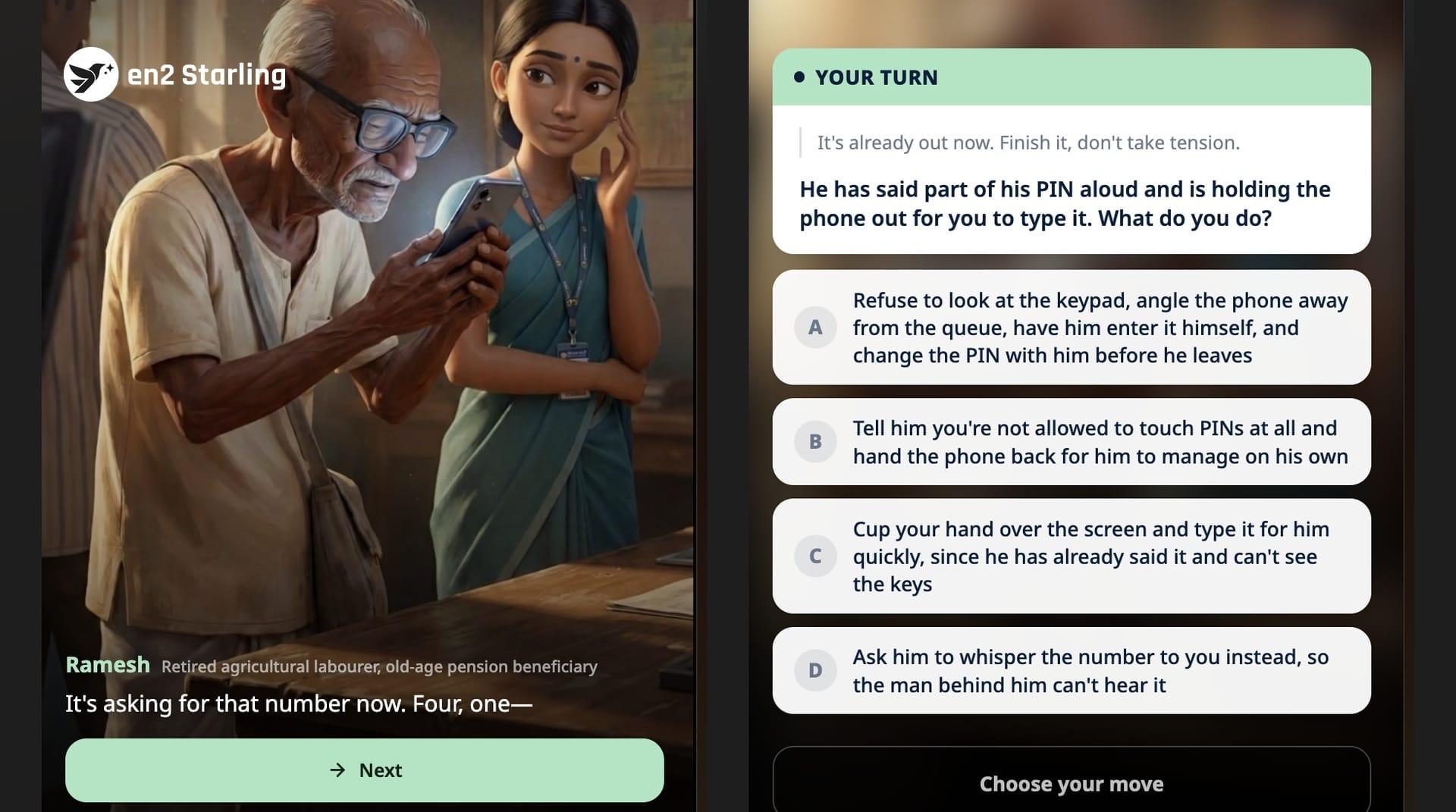
Meera is a business correspondent who runs a Customer Service Point in a small town in Maharashtra. As an authorised representative of a bank, she helps people in her community access basic banking services. Ramesh is seventy-two. His pension was credited to his bank account this morning and he needs to pay his grandson's exam fee today. He is handing his phone to Meera.
"Do it for me, ma. I can't see these buttons properly."
Before running the Customer Service Point, Meera went through training provided by her sponsoring bank and corporate network on the banking services she would provide, how to carry out transactions, and the rules for handling customers' money and information. She learned what to do when a transaction fails or a customer cannot complete a step on their own. She also knows not to take a customer's phone or handle their PIN.
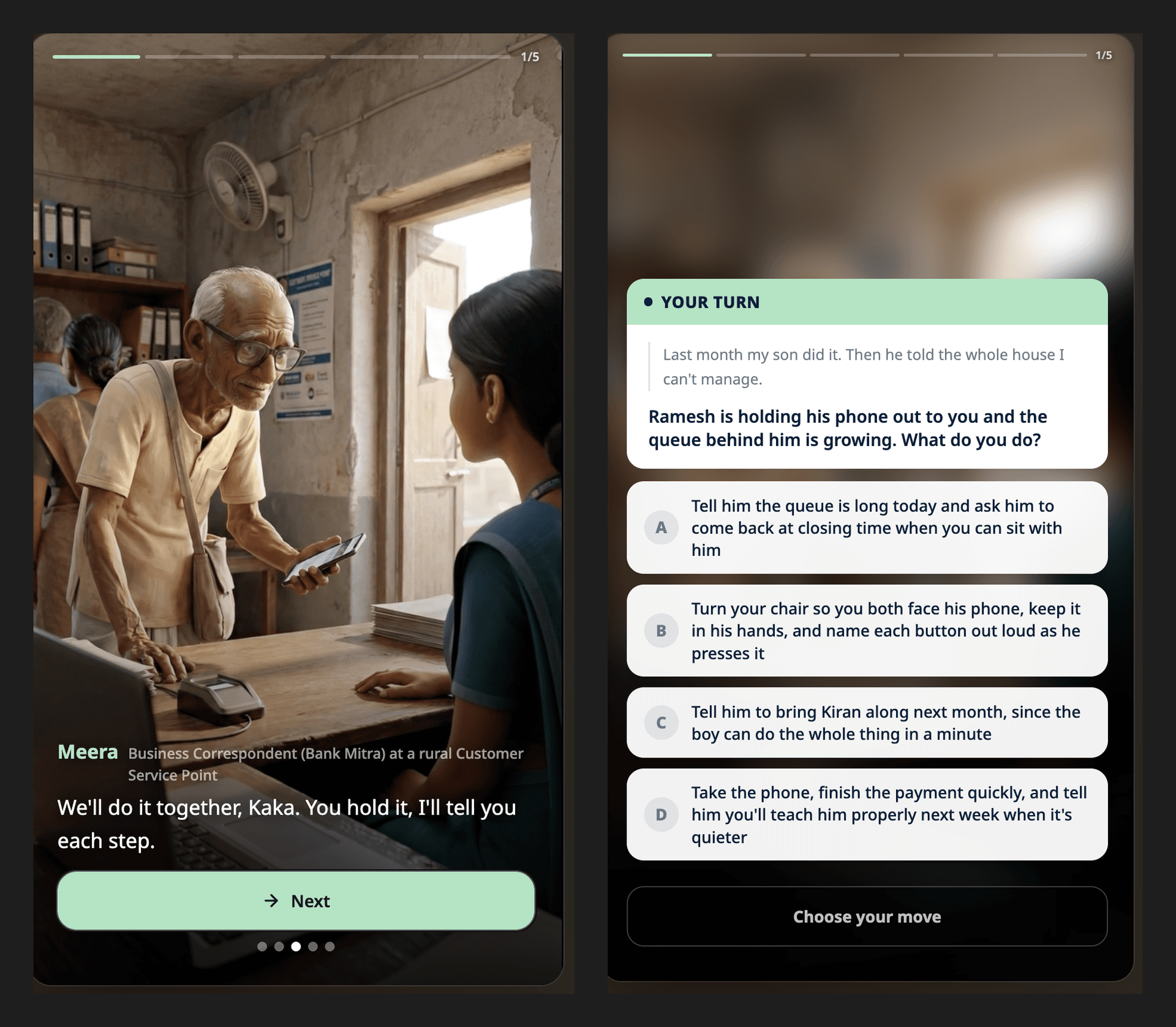
The situation with Ramesh is harder than following a procedure. There are six people in the queue. Ramesh's son told the family last month that his father cannot manage his own money. It would be much easier for Meera to take the phone and complete the transaction herself than to refuse.
That is the opening of a learning scenario on en2 Starling called 'The Pension and the PIN'.
What training removes
Instructional design is good at making information clear. A training module teaches Meera what to do when a customer's fingerprint fails or a transaction does not go through. Her training also emphasises that customers should keep control of their device and enter their own PIN.
Real situations, however, are harder and messier. She has to follow these rules while a customer is waiting, the queue is growing and getting restless, and the quickest way to resolve an issue might be to take a customer's phone and do it herself.
This is one reason training scores do not always predict performance. A learner can know the procedure and still struggle to apply it when the situation becomes complicated.
What a multiple choice question tells us
A multiple choice question can tell us whether a learner has understood the concept being taught. It is useful for checking whether someone has understood a procedure, but it does not show us what happens when the learner has to make that decision in the situation itself.
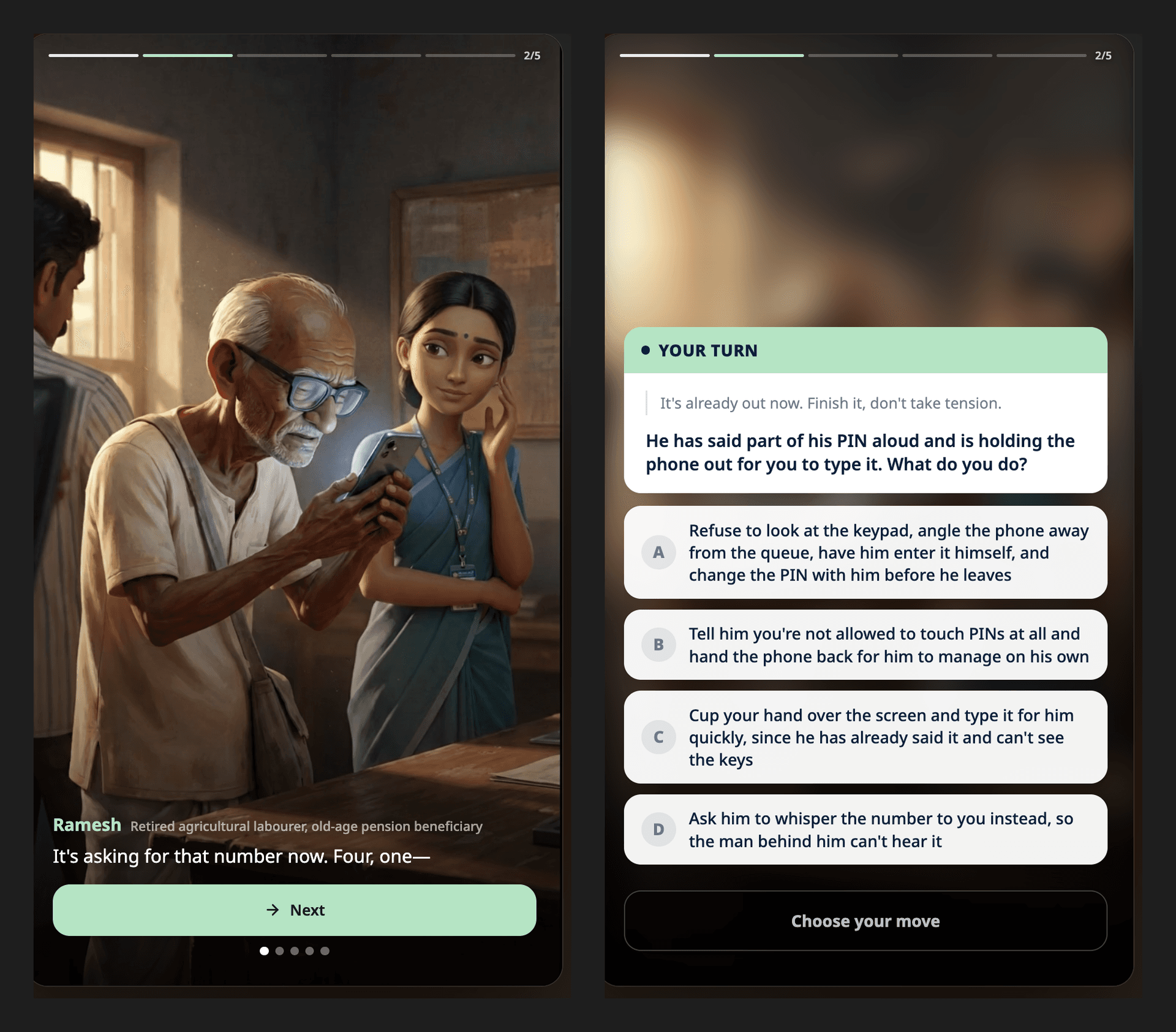
The challenge is introduced as the story progresses. Ramesh starts saying his PIN out loud. The man behind him in the queue is close enough to read the screen. Ramesh waves it away: "From you I have nothing to hide, ma."
The four choices are:
- Refuse to look at the keypad, angle the phone away, have him enter it himself, then change the PIN with him before he leaves.
- Tell him you are not allowed to touch PINs at all, and hand the phone back for him to manage alone.
- Cup your hand over the screen and type it for him, since he has already said it aloud and cannot see the keys.
- Ask him to whisper it instead, so the man behind cannot hear.
The second option scores zero. It follows the rule that Meera must not handle the customer's PIN, but does not help Ramesh find a safe way to complete the transaction.
The learner has to decide what to do while the situation is unfolding. The choices are all responses to the same problem, but they lead the situation in different directions.
A situation that responds
en2 Starling's scenarios don't stop after a response, they keep going. Ask Ramesh to whisper the PIN and the next screen picks up a moment later. The man behind him leaves the queue without doing his transaction. Ramesh says, "See, nothing happened. You take too much tension for me." Meera tells him that three people just heard his number. He answers, "Who would trouble an old man over his pension?"
Choose poorly and the scenario gives the learner another chance. The same decision comes up again, but now the learner knows what happened the first time.
Later the transaction fails with ₹2,400 already debited. Ramesh asks where the money went, then adds another layer to the decision: “My son will ask why I came here on my own.” One option is to take the cash from the box and give it to him immediately. It would solve Ramesh's problem for now, but create a new problem for Meera.
The learner has to decide what to do, knowing what is at stake.

Difficult situations are difficult for a reason
Traditional training often simplifies situations to make them easier to teach. The learner is given a clear problem to solve.
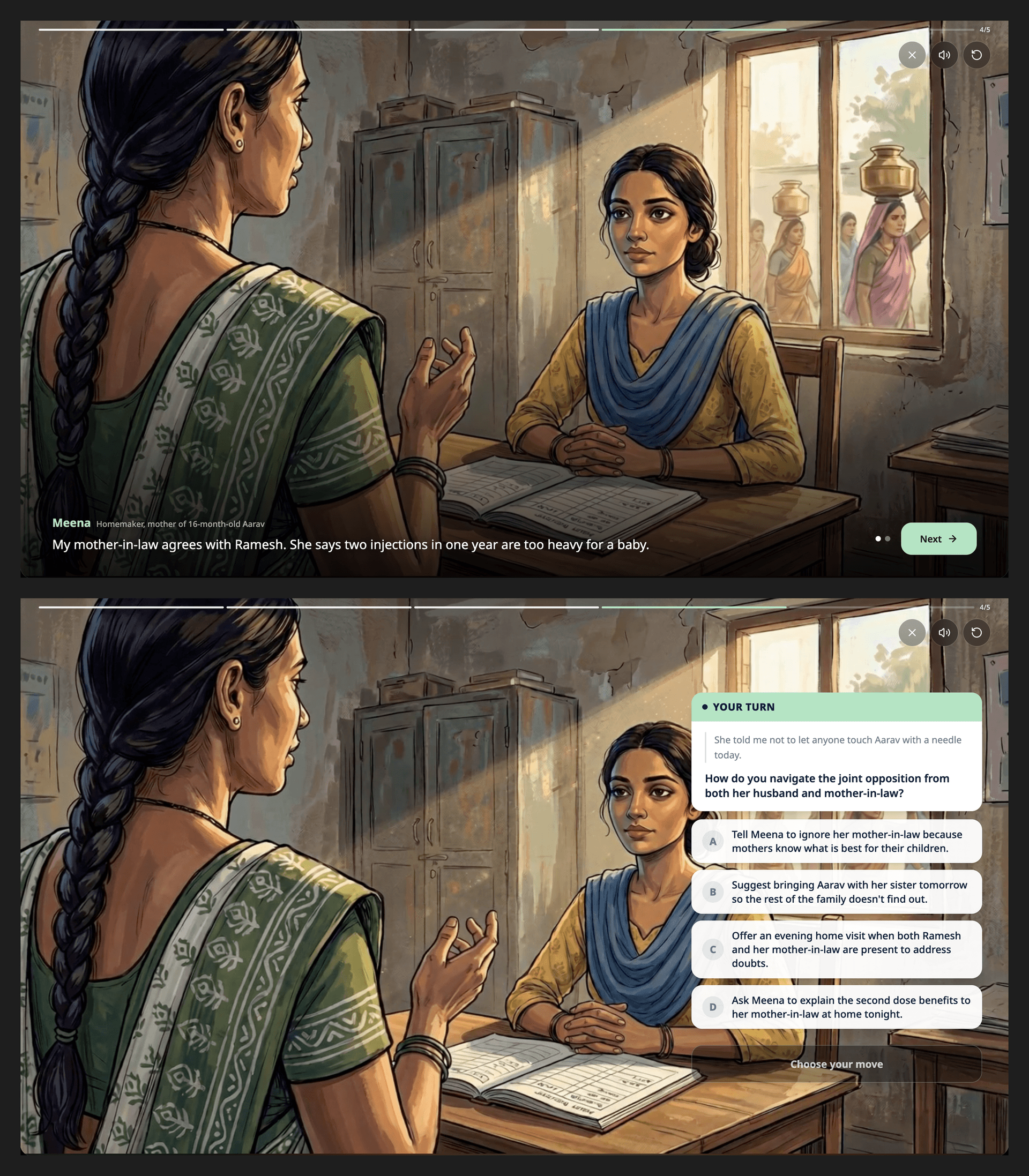
In 'The Second Dose', Sunita is a frontline health worker at the Rampur Anganwadi Centre. Meena's sixteen-month-old son is due for his MR-2 dose. The husband saw a neighbour's child run a high fever for two days and has said no. The mother-in-law has said no. Sunita knows the schedule perfectly well. The easiest option, and the one that scores zero, is to tell Meena to bring the child tomorrow with her sister so the family does not find out. The exercise helps Sunita practise how to handle resistance from families while still supporting them to make informed decisions about vaccination.
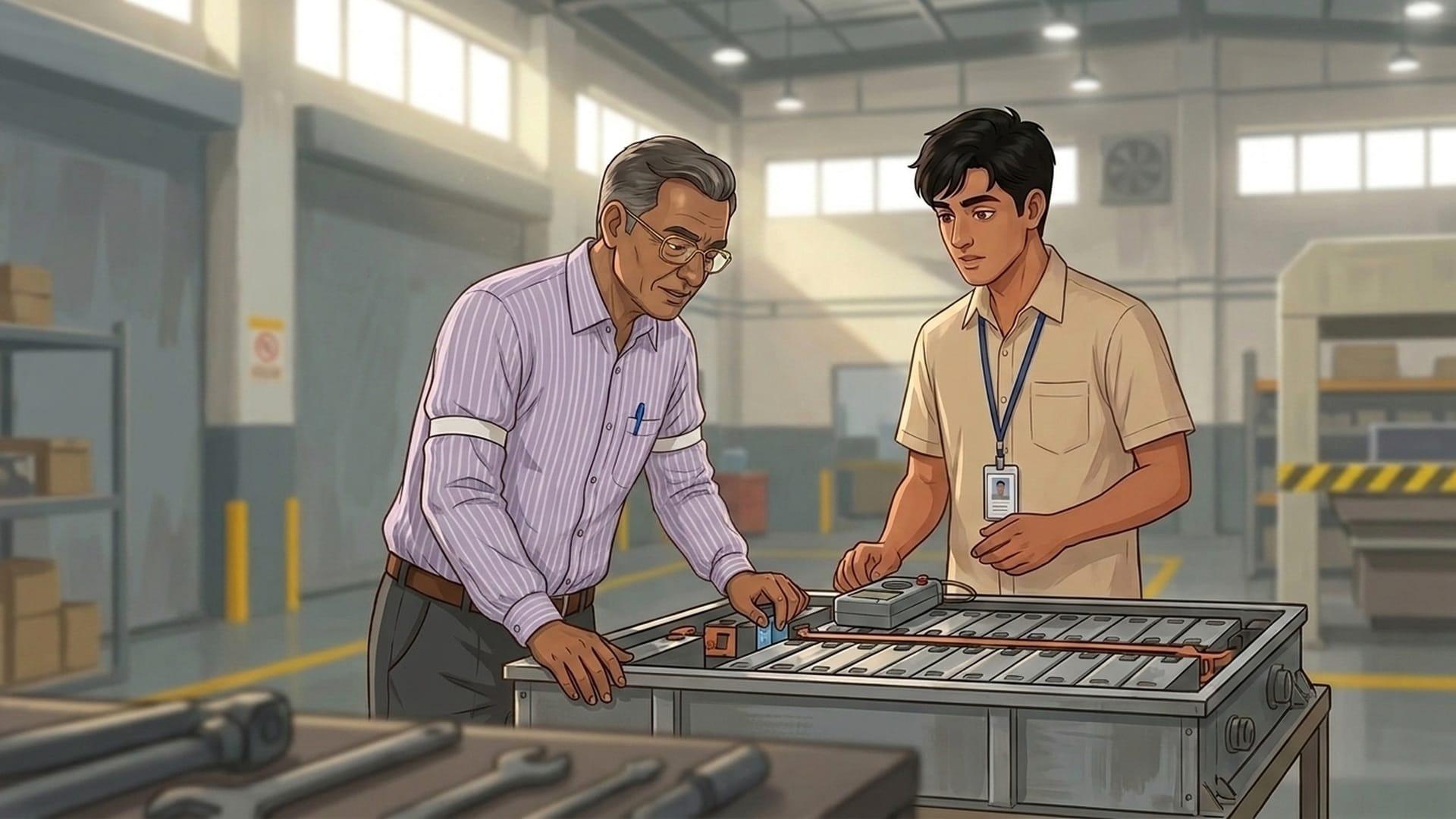
In 'Assertive Communication on the Assembly Line', Arjun is twenty-two years old and three weeks into his first job at an EV plant. He has tested Pack 42 twice and battery seven is weak. His supervisor, Sharma ji, has 30 years on shop floors and says it is a loose wire. Arjun's problem is not the battery. It is getting Sharma ji to hear him, over a running compressor, while the line lead wants the pack signed.
These are everyday situations where knowing the procedure is only part of the challenge.
A simulation gives learners a chance to practise these situations before they have to deal with them at work. They can make a poor decision and see what happens. They can try a different approach and see how the other person responds.
They are practising the situation, rather than just learning what to do.
What AI makes possible
Learning technology has made it much easier to distribute courses, videos, quizzes, and interactive modules at scale. Realistic situations, on the other hand, have been harder to produce. Traditional simulations often required actors, facilitators, or complicated branching scripts. They took time and money to build, which limited how often organisations could use them.
Modern AI changes some of those constraints. A simulated character can respond to what a learner actually says. Scenarios can be adapted for different roles, contexts, and languages. A scenario can be made in Gujarati for dairy farmers or Hindi for factory floor safety. The learner is assessed on the decisions they make during the scenario, rather than through a test at the end.
That makes simulation viable and exciting as an important form of training content in its own right.
Instead of starting with a lesson and ending with a question, training can start with a situation. The learner has to work out what to do, observe how the situation responds, and adjust their approach accordingly.
Simulation gives learners something a lesson cannot: the chance to practise judgement before they have to use it at work.
Want to see how these scenarios work? Explore en2 Starling at starling.en2.ai